
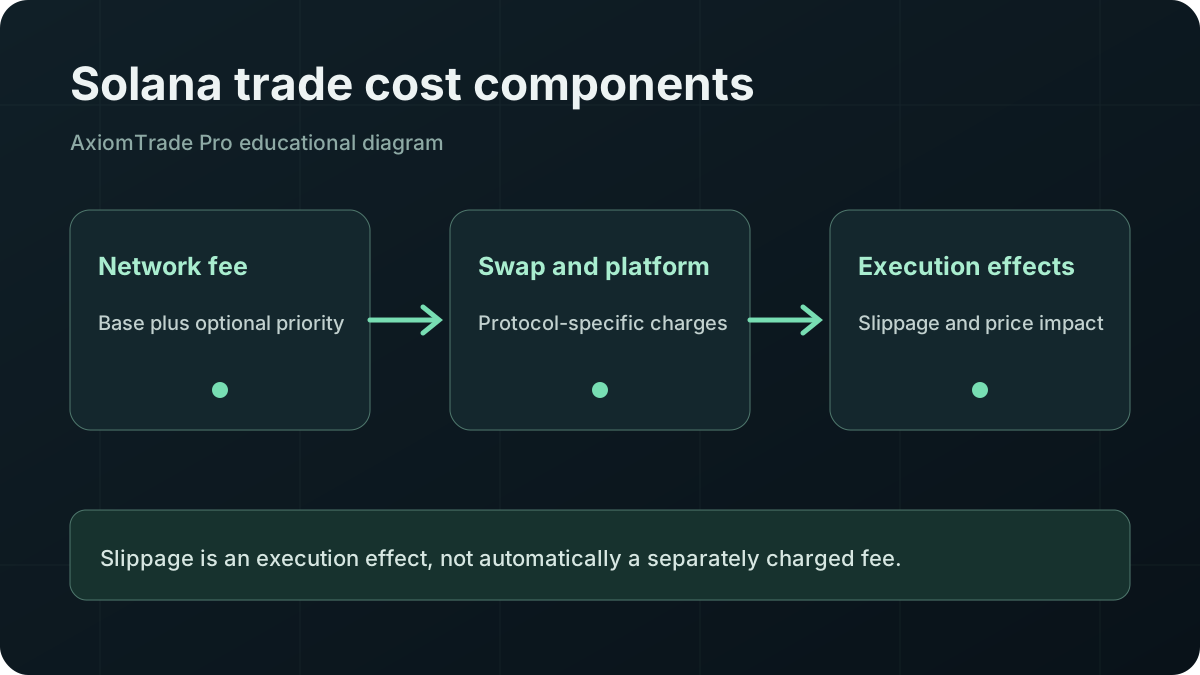
Solana trading costs are not one fee. Every transaction has a SOL-denominated base fee; a transaction may also include a priority fee. A swap can involve liquidity-provider or routing economics, a trading terminal may charge a platform fee, Token-2022 assets can have token-level transfer behaviour, and some submission services use optional tips. Price impact and slippage affect execution but are not necessarily separately charged fees. Read the transaction quote and instructions because the total varies by route, programs, signers, compute budget, market conditions and platform.
01 / NETWORK LAYER
Solana Base Transaction Fees
Solana’s official documentation says every transaction requires a fee paid in SOL. The base component covers signature verification and is charged per signature, including applicable precompile signature verification. The fee payer’s account funds it before execution.
The protocol documentation currently lists a lamport amount per signature, but converting it into a universal USD figure would be misleading: the number of signatures can differ, SOL’s market price changes and transactions can include other components. A wallet or terminal estimate immediately before signing is more useful than a static dollar claim.
It pays for transaction processing mechanics. It is separate from the tokens exchanged, platform charges and any adverse difference between quoted and executed output.
02 / OPTIONAL PRIORITY
Priority Fees and Compute Units
For legacy and versioned-v0 transactions, Solana documents the prioritisation fee as a function of the requested compute-unit limit and the price assigned per compute unit. The fee is based on the requested limit, not the compute units ultimately consumed, so an unnecessarily high limit can pay for unused capacity. Solana’s newer v1 transaction format expresses priority differently as an absolute lamport total in message configuration. The focused priority-fee guide shows the formula, dimensional conversions and version caveat.
A higher priority fee can make the scheduler more likely to place a transaction ahead of competing traffic. It does not guarantee inclusion, success or a particular execution price. Axiom’s documentation exposes a priority setting in its Solana workflow, but current interface values should be checked live rather than copied from this article.
03 / MARKET ROUTE
Swap Routing and Liquidity-Provider Fees
A swap invokes one or more onchain programs and liquidity sources. Depending on the venue and route, the pool’s design may charge a fee or incorporate economics that compensate liquidity providers. An aggregator route can split an order across pools. The exact amount and recipient should be taken from the current quote, route details and program instructions—not assumed from Solana’s network fee.
Token mechanics can also affect the received amount. Solana’s Token Extensions documentation describes, among other optional features, transfer-fee configuration and transfer hooks. A Token-2022 mint using such extensions can behave differently from an ordinary original Token Program mint. Verify the mint’s program and enabled extensions.
04 / APPLICATION LAYER
Trading Terminal and Platform Fees
A terminal can charge for facilitating a trade in addition to the network and liquidity path. The charging basis may be a percentage of notional value or another disclosed method. Those terms belong to the platform, not the Solana protocol.
This ecosystem article intentionally does not duplicate Axiom’s current rate schedule. Use the dedicated Axiom fees guide and calculator, which cites the platform’s documentation, distinguishes gross fee and tier-based cashback terminology, and states its verification limits. Always check the live order summary and official documentation because commercial terms can change.
05 / NOT THE SAME AS FEES
Price Impact and Slippage
Price impact is the change in average execution caused by the order consuming available market depth. It can already be embedded in the quote. Slippage is the difference between the quote and final execution as pool state, routing or market prices change. Neither has to appear as a separately transferred “fee,” yet both can make the economic result worse.
For example, paying a small explicit network charge does not mean a thin-market trade is inexpensive. The output lost to poor depth can dwarf a visible fee. The Axiom slippage guide shows how tolerance differs from actual execution and why a percentage should not be treated as a guaranteed cash-loss cap.
06 / OPTIONAL COMPONENTS
Tips and Other Transaction-Related Charges
Some transaction-delivery paths include an optional validator, block-engine or MEV-related tip. Axiom’s documentation separately describes priority, bribe and MEV controls. These are product-specific submission choices, not a single mandatory “Solana gas fee.” Their availability, labels and behaviour can change.
Account creation can also require funding for account storage. For example, receiving a new token may require an associated token account. Solana documentation describes a refundable minimum balance for that account’s storage; it is different from a validator transaction fee and may be returned when an eligible account is closed. Which party pays depends on the transaction design.
07 / FAILURE CASES
Failed Transaction Costs and Limits
Solana’s fee-structure documentation says the transaction fee is deducted before execution and remains charged when execution fails. Program state changes are rolled back, but processing was still attempted. A failed swap can therefore leave the user with no purchased tokens and a smaller SOL balance from the transaction fee.
Not every unsuccessful attempt is an executed failure. A transaction can be dropped or expire without being landed, and an interface can reject it before broadcast. Use the signature and explorer status to distinguish cases. Reasons for onchain failure include program errors, unmet minimum output, insufficient funds, invalid account state and exceeded compute limits.
It changes scheduling economics. It cannot guarantee that program conditions remain valid or that a volatile market provides the quoted output.
08 / HYPOTHETICAL MODEL
Educational Breakdown of a Hypothetical Trade
Assume a user wants to exchange an input notionally worth $250. The interface shows an estimated output. To analyse cost without inventing rates, label each variable:
| Component | How to identify it | Treatment |
|---|---|---|
| Base fee | Fee estimate and landed transaction | Network charge in SOL |
| Priority fee | Compute/message settings and transaction | Optional network scheduling charge |
| Pool or route fee | Quote and invoked program details | Protocol/market-path cost |
| Platform fee | Terminal quote and official terms | Application-level charge |
| Optional tip | Submission settings and instruction transfers | Route-specific incentive |
| Price impact | Compare marginal price with quoted average | Execution effect, not necessarily a fee |
| Slippage | Compare quoted and final output | Execution difference, not necessarily a fee |
The economic result is best evaluated from final balance changes plus explicit charges. Do not simply add a tolerance percentage as if it were automatically paid.
09 / VERIFICATION WORKFLOW
How to Review Transaction Costs and Why They Change
- Before signing, record the input amount, quoted output, minimum output and each labelled fee.
- Check the exact token mint, route and any Token-2022 extensions.
- Review the requested priority or optional tip separately from the base fee.
- After processing, open the transaction signature and inspect fee, status, instructions and pre/post balances.
- Compare the final output with the quote; do not call every difference a fee.
Costs change with signature count, compute configuration, network demand, submission settings, route choice, liquidity, order size, token extensions, platform terms and asset prices. The Axiom usage guide covers the interface workflow, while the safety guide explains why transaction review matters.
10 / PRIMARY EVIDENCE
Sources and Method
- Solana — Fees overview
- Solana — Fee structure
- Solana — Compute budget
- Solana — Token Extensions
- Axiom — Solana settings
Checked 19 October 2026. Protocol mechanics come from Solana’s official documentation. Platform examples are clearly separated and do not assert a universal dollar cost.
11 / FAQ
Frequently Asked Questions
What fees does every Solana transaction pay?
Every transaction has a SOL-denominated base fee. Other components, including priority, depend on the transaction and settings.
Is a Solana priority fee mandatory?
The priority component is optional. It can improve scheduling priority but does not guarantee confirmation, success or execution price.
Is slippage a Solana transaction fee?
No. Slippage is an execution difference between quote and result, not necessarily a separately charged network fee.
Can a failed Solana transaction charge a fee?
Yes. Solana’s official fee documentation states that the fee is charged whether execution succeeds or fails.
Why can two swaps of equal value cost differently?
They may use different signatures, compute settings, programs, routes, pools, token extensions, platform terms and market depth.
Can I calculate a universal Solana trading fee in USD?
No. SOL price, transaction construction, route and application charges vary. Use the live estimate and landed transaction.
12 / THE TAKEAWAY
Audit the Layers, Not One Headline Number
Start with protocol fees, then identify priority and optional submission charges, pool or route economics, and the platform’s own terms. Finally, assess price impact and slippage as execution effects. This layered method makes a trade’s real cost easier to understand without pretending that one fixed USD figure applies across Solana.