
Interpret wallet trading activity in layers. First identify the exact transaction type and token mint. Next place the event in a timeline with preceding funding, later transfers and related accounts. Then compare size with the wallet’s visible capital and the market’s liquidity. Finally, write down what remains unknown: offchain positions, other wallets, hedges, cost basis, ownership and intent. Never turn one observed buy into a recommendation; a later copy has a different price, depth, timing and risk.
01 / OBSERVABLE FACTS
What Public Wallet Activity Reveals
A public blockchain can show signed transactions, program instructions, token-account balance changes, timestamps or slots, transaction fees and account relationships. With correct decoding, those records can establish that a particular address authorised or participated in an onchain event.
They do not automatically reveal why the event happened, who beneficially controls every account, whether the address has offchain exposure, or whether a visible position is hedged elsewhere. The difference between evidence and narrative is the foundation of sound wallet analysis.
Write “the account swapped X for Y” before writing “the trader is bullish.” The first can be verified; the second requires context.
02 / CLASSIFY THE EVENT
Buys Versus Sells Versus Transfers
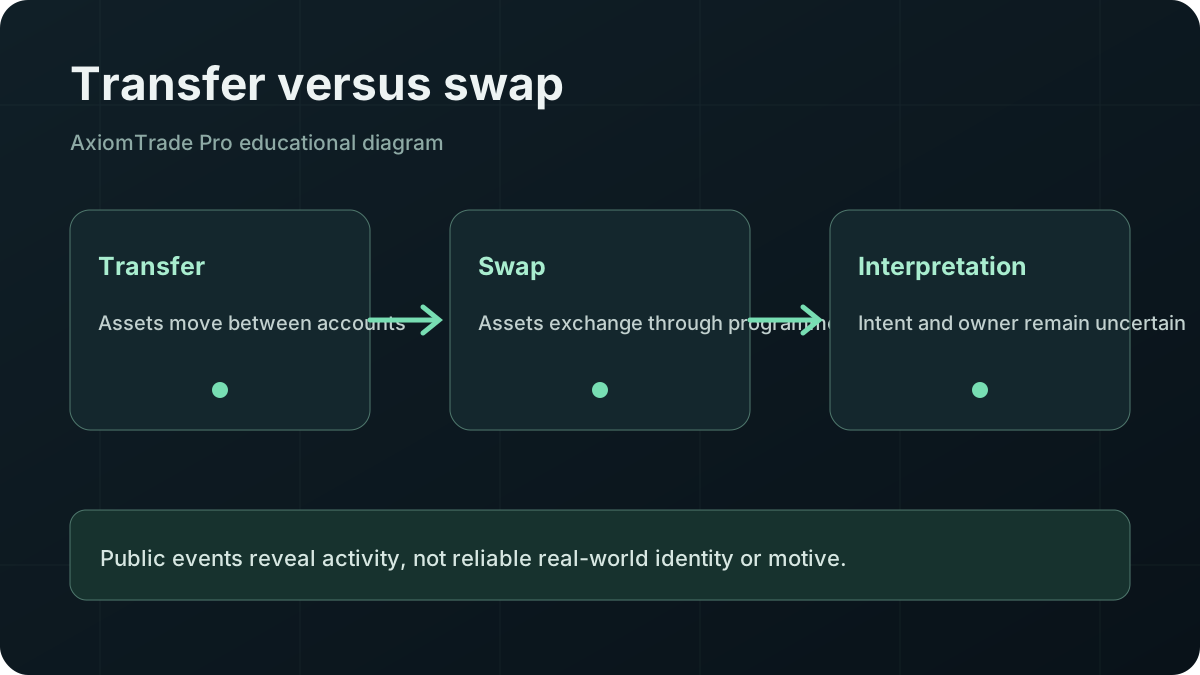
A swap exchanges assets through one or more programs. A transfer moves an asset between accounts without necessarily exchanging it. A liquidity action deposits or removes assets from a pool and can resemble several transfers. Minting, burning, account creation and wrapping SOL add still more possibilities.
| Event | Supports | Does not prove |
|---|---|---|
| Swap into token | The visible account increased token exposure in that event | Long-term conviction or complete position |
| Swap out | The visible account reduced exposure | A full exit or negative view |
| Incoming transfer | Tokens arrived from another account | A purchase or unrelated sender |
| Outgoing transfer | Tokens moved to another account | A sale or realised profit |
| Liquidity action | Assets interacted with a pool | A simple directional trade |
Use the technical guide to read Solana transactions when classification is unclear.
03 / TIME CONTEXT
How Transaction Timestamps Can Mislead
Explorers may display block time, which is useful but not a perfect record of when a person made a decision. A transaction can be prepared earlier, retried, routed through automation or observed only after indexing delay. Several events in one block do not establish which party saw another’s order.
Timezone display can also create apparent day boundaries that do not exist in UTC. Sort by slot and signature where appropriate, and distinguish submission, processing, confirmation and finality. When analysing a copied trade, include the delay between the original event, your alert, your review and any later execution.
04 / RELATIVE EXPOSURE
Why Transaction Size Needs Context
A $10,000 swap can be meaningful for one wallet and trivial for another. Compare the event with visible wallet value, prior position size, average acquisition history and market depth. A large notional buy may simply rebalance a portfolio or route capital between assets.
Token quantity alone is even less informative because decimals and unit prices differ. Use consistent value measures at the time of the event, disclose the price source and avoid implying that visible wallet value equals total wealth.
05 / ATTRIBUTION
Wallet Clusters and Attribution Uncertainty
Shared funders, repeated counterparties, coordinated timing and transfers among addresses can support a hypothesis of related control. They cannot conclusively identify a person. Exchanges, launch tools, multisignature systems and custodians create shared patterns among unrelated users.
The holder-analysis guide explains token accounts, owner addresses and beneficial ownership. Use labels such as “possibly related” and keep alternative explanations beside the evidence. Do not publish private-person identity claims.
06 / DIFFERENT TRADE, DIFFERENT RESULT
Liquidity and Execution Differences
The tracked wallet’s order changes the market before a follower acts. Your order may face a new reserve balance, wider spread, additional competition or less liquidity. The tracked address may have acquired tokens before public attention or through a private allocation.
Even a short delay can matter in a volatile pool. Compare intended size with current depth, quote and price impact. A wallet’s historical execution is not available to a later participant. This is why the wallet monitoring workflow treats alerts as research prompts rather than copy instructions.
07 / PERFORMANCE LIMITS
Realised Versus Unrealised PNL Limitations
Realised PNL requires a defensible cost basis and disposal calculation. Unrealised PNL applies a current valuation to an open balance. Both can be distorted when tokens arrive by transfer, cost basis begins before the observed window, positions span several wallets, or illiquid balances are marked at a marginal price.
A displayed PNL may exclude network fees, platform charges, funding, failed attempts, external trades or transfers. A wallet can show a profitable realised sale while retaining a larger losing balance elsewhere. Before comparing wallets, inspect the metric’s inputs and coverage.
08 / BEHAVIOUR OVER TIME
Repeated Activity and Behavioural Patterns
A pattern becomes more informative when it repeats across comparable situations. Useful dimensions include holding time, order size relative to liquidity, entry timing, scale-in and scale-out behaviour, reaction to losses, token age and use of multiple accounts.
Still, the historical pattern is descriptive. Strategy can change, survivorship bias can hide abandoned wallets, and selection based on recent winners can make ordinary variance look like skill. Record losing and inactive periods, not only memorable successes.
09 / HYPOTHETICAL TIMELINE
Educational Wallet Timeline
Consider a fictional wallet:
- 09:00: receives 20 SOL from an exchange-labelled address. This supports funding, not the owner’s identity.
- 09:08: swaps 5 SOL for Token A. This is a visible acquisition at that market state.
- 09:10: transfers half the tokens to Wallet B. It is not yet a sale.
- 11:30: sells one quarter of the original amount. Realised PNL requires the relevant cost basis and charges.
- Next day: Wallet B sells its balance. Shared control is possible, but the earlier transfer alone did not prove it.
A naive summary—“bought, then sold for profit”—misses the transferred balance, attribution uncertainty, partial exit and changing liquidity.
10 / ANALYSIS WORKFLOW
Wallet Activity Research Checklist
- Verify the wallet, mint, pool and transaction signature.
- Classify swaps, transfers, liquidity actions and account setup separately.
- Use a timeline and record the observation window.
- Compare size with visible capital and current market depth.
- Trace funding and destinations without asserting identity.
- Separate realised, unrealised and unknown PNL components.
- Include fees and incomplete cost basis in limitations.
- Check related addresses and alternative cluster explanations.
- Compare repeated behaviour, including losses and inactivity.
- Make an independent decision; never copy automatically.
The Axiom Wallet Tracker guide covers the feature itself. This article’s narrower purpose is interpreting what the resulting activity may mean.
11 / COMMON ERRORS
Common Interpretation Mistakes
- Calling every incoming transfer a buy.
- Assuming one address represents the complete strategy.
- Using current price to value historical execution.
- Treating a large trade as large without wallet and liquidity context.
- Reading an explorer label as verified identity.
- Ignoring failed transactions and fees.
- Calculating PNL from an incomplete acquisition history.
- Copying after the original trade changed the market.
A wallet event can guide further research, but it cannot transfer the original trader’s timing, information, cost basis or risk capacity to you.
12 / PRIMARY EVIDENCE
Sources and Method
- Solana — Transactions
- Solana — Token accounts
- Axiom — Monitor Wallets
- Axiom — Portfolio and PNL fields
Checked 19 October 2026. Protocol facts and documented interface fields are separated from analytical inferences. Hypothetical events use fictional wallets.
13 / FAQ
Frequently Asked Questions
Does an incoming token transfer mean a buy?
No. It shows movement between accounts; inspect the surrounding instructions and funding to identify a swap.
Can wallet activity reveal trader intent?
It can support hypotheses, but one event rarely proves motive, holding period or future plans.
Why should I not copy a tracked wallet?
Your price, delay, liquidity, cost basis and risk differ, while the tracked address may show only part of the original strategy.
Is wallet PNL always accurate?
No. Transfers, missing history, illiquid marks, fees and other wallets can make a displayed estimate incomplete.
Can I identify a person from an address?
Usually not reliably. Public disclosures may label some entities, but an address alone is not a verified identity.
What makes a wallet pattern meaningful?
Repeated, comparable behaviour with complete context is more useful than one event, but it still does not predict future performance.
14 / THE TAKEAWAY
Use Wallet Activity to Ask Better Questions
Good interpretation classifies the event, reconstructs the timeline, measures relative size, tests attribution and states what remains unknown. The result should be a better research question—not an automatic buy or sell signal.