
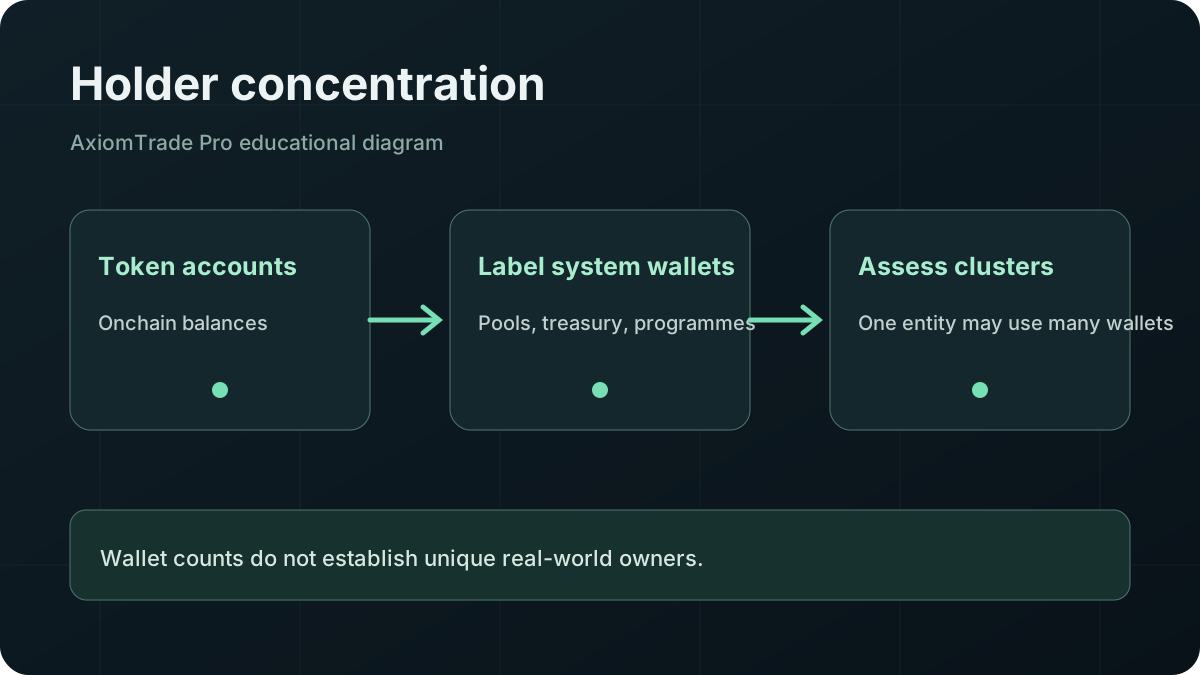
Verify the exact mint, export or inspect its largest token accounts, then map each token account to its owner address where the data permits. Label known liquidity pools, treasuries, bonding curves, vesting or program-controlled accounts before calculating concentration. Review funding sources, transfer timing and trading behaviour for possible clusters, but describe those links as evidence—not proof of common real-world ownership. A wallet can own multiple token accounts, one entity can control many wallets and a custodian can represent many users.
01 / START WITH THE DATA MODEL
What a Token Holder Represents
Solana’s Token Program stores balances in token accounts. Each token account records the mint it holds, an owner with authority over that account and an amount. A wallet usually uses an associated token account for a given mint, but Solana’s documentation states that a wallet can own multiple token accounts for the same mint.
This creates an important distinction: a “holder” displayed by an explorer may mean a token account, an owner address after aggregation, or a provider-specific entity label. Before comparing counts, learn which definition the interface uses. None of those definitions automatically equals a unique human investor.
02 / DISTRIBUTION VIEW
How to Inspect Holder Distributions
- Confirm the complete mint address from trusted sources.
- Open the mint in a Solana explorer and locate the largest token accounts or owners.
- Record balances and percentages at the same block or observation time.
- Resolve token-account owners and label known program-derived or protocol accounts.
- Inspect representative transaction histories and funding relationships.
- Repeat later to distinguish a snapshot from a developing pattern.
Keep raw observations separate from interpretations. “Address A transferred to B” is observable; “A and B are the same person” is generally an inference. The tutorial on reading Solana wallet transactions explains signatures, instructions and balance changes.
03 / TOP HOLDER CONCENTRATION
How to Read the Largest Balances
Concentration measures how much of supply sits in a selected set of accounts or attributed owners. A high figure can indicate that a few parties could materially affect the market if they sell, transfer or exercise governance. But raw top-holder percentages can be distorted by pool vaults, burned units, treasuries and custodial addresses.
Calculate more than one view: top ten including every account; top ten excluding clearly labelled pool or burn accounts; and concentration among addresses that appear economically independent. State every exclusion. Do not quietly remove inconvenient accounts or treat uncertain labels as facts.
| Signal | Possible meaning | Required follow-up |
|---|---|---|
| One very large token account | Pool, treasury, custodian or whale | Resolve owner and instruction history |
| Several similarly funded wallets | Possible coordinated cluster | Compare funder, timing and later actions |
| Falling concentration | Distribution or wallet splitting | Trace destinations and beneficial control clues |
| Rising holder count | Adoption, dusting, incentives or splitting | Review balance sizes and acquisition paths |
04 / SYSTEM ACCOUNTS
Liquidity Pools, Treasury Wallets and Program-Controlled Accounts
Liquidity pools commonly hold token balances in vaults controlled by a program or authority design. A large pool balance supports trading and should not automatically be described as a whale’s discretionary holding. Treasury, vesting, bonding-curve and staking accounts likewise require their own interpretation.
Verify labels using program ownership, documented pool addresses and instruction history. Explorer labels are useful leads, not infallible identity attestations. If a top account cannot be classified, leave it “unlabelled” and explain the uncertainty rather than guessing.
The market cap versus liquidity guide explains why pool balances and token valuation answer different questions.
05 / POSSIBLE COMMON CONTROL
Multiple Wallets Controlled by One Entity
One actor can divide tokens across many wallets, making a distribution look broader. Clues can include a shared initial funder, transfers in the same block, repeated equal-size purchases, identical program interactions and coordinated exits. Clustering methods combine these clues, but they remain probabilistic.
Coincidence and shared infrastructure create false positives. Exchange withdrawals can fund unrelated users from one hot wallet; automated launch tools can give many users similar transaction patterns; airdrops can distribute identical amounts. Use neutral language such as “possibly related cluster” and list the evidence.
06 / ATTRIBUTION LIMITS
Token Accounts Versus Beneficial Owners
The Token Program’s owner field identifies the address authorised to control a token account. It does not contain a legal name, company registration or verified human identity. Program-derived addresses can be controlled by program rules rather than a private key. Multisignature arrangements, custodians and smart-contract vaults further separate onchain authority from economic beneficiaries.
Public onchain data therefore cannot reliably establish the real-world owner of every wallet. Do not dox private people, repeat unverified names or convert a social-media claim into fact. Attribute identities only when supported by an authoritative public disclosure, and preserve the distinction between “labelled as” and “proven to own.”
Account control and beneficial ownership are different layers. Holder analysis can identify risk patterns without making private identity claims.
07 / TIME SERIES
How to Interpret Holder Count Changes
A rising count can reflect genuine adoption, but also dust transfers, promotional distributions, wallet splitting or many accounts with negligible balances. A falling count can result from consolidation, account closure, selling or a provider changing its counting method.
Segment balances where possible. Compare the number of material holders with dust accounts, and track how much supply each segment controls. Align count changes with transfers, liquidity events and price movement. Avoid treating a smooth upward line as proof of a healthy community.
08 / TRANSACTIONS IN CONTEXT
Transfer and Trading Patterns
A transfer between token accounts is not necessarily a sale. It can be internal custody movement, a distribution, a pool deposit or an exchange transfer. A swap contains program instructions and paired balance changes that are different from a simple transfer. Always inspect the complete transaction.
Useful questions include: Did the address acquire tokens via a swap, minting, transfer or liquidity action? What funded its SOL fees? Did it interact with the same pool as related wallets? Did tokens move onward immediately? Are gains calculated from complete acquisition history or only visible trades? The Axiom wallet tracker guide explains these interpretation limits.
09 / AVOID SHORTCUTS
Common False Signals
- “Many holders means decentralised.” One entity can control many addresses, and dust accounts inflate counts.
- “Top ten includes the pool, so insiders own everything.” Label program and market accounts first.
- “A transfer out is a sale.” It may be a move between accounts under related control.
- “No single whale means low concentration.” Related wallets can split a position.
- “A profitable wallet proves skill.” Missing cost basis, transfers and other wallets can distort PNL.
- “An explorer label proves identity.” Labels can be incomplete, outdated or provider-generated.
10 / PRACTICAL RESEARCH
A Repeatable Holder Analysis Workflow
- Record the mint, observation time, supply and data provider.
- Export or capture the largest token accounts and balances.
- Map token accounts to owner addresses where possible.
- Label verified pools, treasuries, burns, vesting and program accounts.
- Recalculate concentration with transparent inclusions and exclusions.
- Trace initial funding, token sources and representative instructions.
- Flag possible clusters with evidence and alternative explanations.
- Compare the snapshot at later intervals.
- Combine distribution with liquidity, authority and metadata checks.
- Write uncertainty beside every unverified attribution.
Start with the wider Solana token safety framework. Axiom’s Pulse documentation describes holder-related filters, but any aggregated field should lead back to underlying onchain evidence.
11 / PRIMARY EVIDENCE
Sources and Method
- Solana — Mint, token account and associated token account concepts
- Solana — Create and understand token accounts
- Axiom — Pulse holder-related fields
- Axiom — Monitor wallets
Checked 19 October 2026. Protocol facts come from Solana documentation. Clustering methods are educational inferences and are never presented as conclusive real-world attribution.
12 / FAQ
Frequently Asked Questions
What is a Solana token holder?
Depending on the tool, it may mean a token account, aggregated owner address or provider-labelled entity. Check the definition.
Can one wallet have multiple token accounts?
Yes. Solana’s documentation states that a wallet can own multiple token accounts for the same mint.
Does one wallet equal one person?
No. One entity can control many wallets, while one custodial or program address can represent many users or rules.
Should liquidity pools count as top holders?
Include them in the raw account table, label them, and present a separate economic-concentration view with exclusions explained.
Does a rising holder count prove demand?
No. Dusting, incentives, wallet splitting and methodology changes can increase the count without broad organic demand.
Can funding links prove common ownership?
They can support a clustering hypothesis but do not prove common real-world ownership by themselves.
13 / THE TAKEAWAY
Label Accounts Before Interpreting Concentration
A useful holder analysis moves from token accounts to owner addresses, from owner addresses to carefully evidenced clusters, and from a snapshot to a time series. Keep program accounts distinct, publish assumptions and preserve uncertainty. The goal is to understand distribution risk—not to manufacture identities from public addresses.