
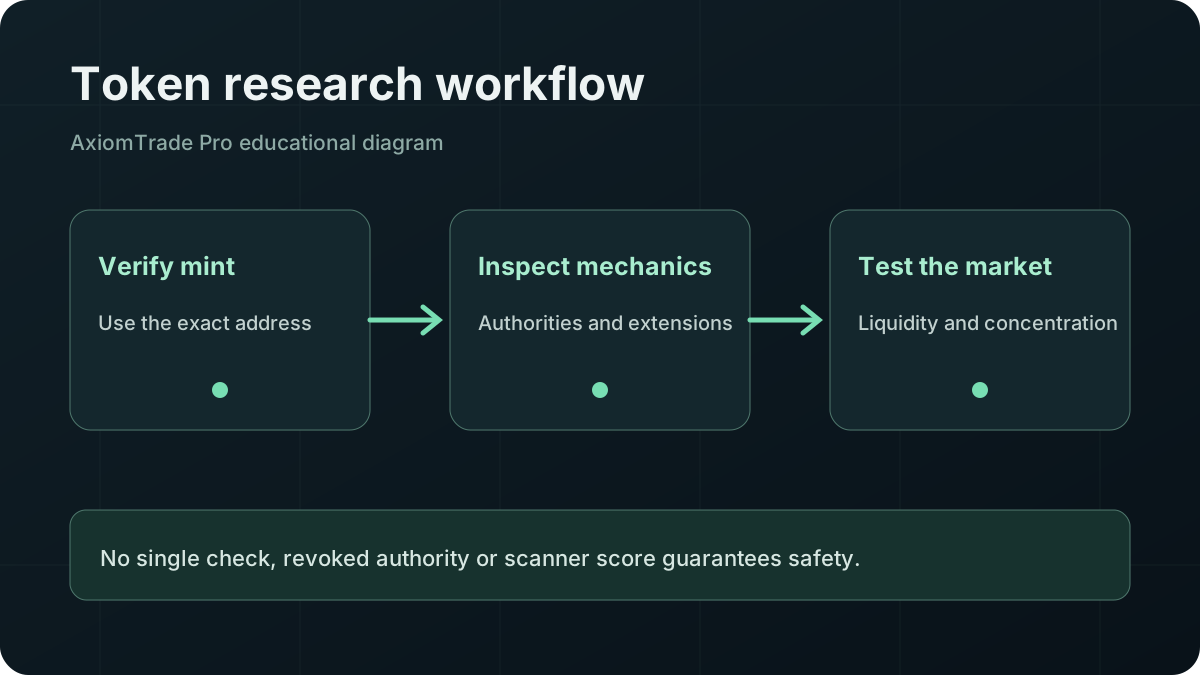
Start with the exact mint address, then verify which Token Program owns it and inspect supply, mint authority, freeze authority and any Token-2022 extensions. Review usable liquidity and market depth, label top token accounts such as pools or treasuries, and trace suspicious transfers or trading clusters. Check whether metadata and social links belong to the same mint. No single condition proves safety: revoked authorities, locked liquidity, dispersed accounts or a passing scanner result can reduce one concern while leaving many others unresolved.
01 / WHY CAUTION MATTERS
Why Newly Launched Tokens Can Be Risky
A new market has little history. Supply may be concentrated, liquidity can be shallow or temporary, metadata can be copied and early participants may have information or cost bases unavailable to later buyers. Automated accounts can generate impressive activity without durable demand. Smart contracts and token extensions may also introduce permissions that a ticker or chart does not reveal.
These risks are independent of the discovery interface. A token appearing in Axiom Pulse means it met the workspace’s inclusion and display logic; it does not mean the token has been certified safe. Treat discovery as the beginning of research.
02 / IDENTITY
Verify the Exact Token Mint Address
Solana’s documentation states that a token is uniquely identified by its mint account address. Names and symbols are human-readable metadata and can be duplicated. A bad actor can create another mint with the same ticker, image and website text.
- Copy the full mint from a primary project channel, then cross-check it in a reputable explorer.
- Compare the mint shown by the market, liquidity pool and wallet prompt.
- Confirm the mint is owned by the expected original Token Program or Token Extensions Program.
- Do not rely on a truncated address without comparing the complete string.
The guide to finding new Solana tokens explains how to move from discovery to mint verification.
03 / EXECUTABLE MARKET
Review Liquidity and Market Depth
Liquidity describes assets available for exchange; market depth describes how much can trade across prices. A displayed pool value is not a guarantee that your order can exit at that value. Pool composition, the pricing curve, concentrated ranges, transfer restrictions and rapid withdrawals can all affect executable depth.
Compare the intended order size with the quote and price impact. Test a hypothetical sell quote without signing. Identify the pool address and examine whether liquidity changed abruptly. “Locked” liquidity, where verifiable, may address one withdrawal path but does not establish fair distribution, honest promotion, safe code or future demand.
Price multiplied by supply does not represent cash backing the token. A high displayed valuation can coexist with a shallow pool.
04 / DISTRIBUTION
Examine Holder Concentration
A large share controlled by a few economically related parties can create selling and governance risk. But a raw “top ten” number is not self-explanatory. Large accounts may be liquidity pools, treasuries, bonding-curve programs, vesting contracts, exchanges or ordinary holders. Label known program-controlled accounts before interpreting concentration.
Also look beyond the first snapshot. Transfers among newly funded wallets, repeated funding from one source and coordinated trading times can suggest common control, but they do not prove real-world identity. The dedicated meme coin holder analysis workflow explains token accounts, beneficial ownership limits and false signals.
06 / PROGRAM DIFFERENCES
Review Token Program Differences and Extensions
Solana supports the original Token Program and the Token Extensions Program, commonly called Token-2022. Token-2022 retains basic token functionality and can enable optional extensions. Official documentation lists features including transfer fees, permanent delegate, default account state, non-transferable tokens, transfer hooks, pausable mint and metadata pointers.
Those features are not automatically malicious; they support legitimate designs. They do change the questions a trader must ask. A permanent delegate can authorise transfers or burns for token accounts of that mint. A transfer hook invokes custom program logic on transfers. A transfer-fee configuration reduces transferred amounts according to its settings. Inspect the exact enabled extensions and authorities rather than applying a blanket label to all Token-2022 assets.
07 / ACTIVITY QUALITY
Look for Suspicious Trading and Volume Patterns
Rapid alternating buys and sells, repeated equal-size transactions, short-lived bursts among a tight address cluster and circular transfers can be reasons to investigate. High volume can reflect organic disagreement, arbitrage, bots, incentives or manipulation; the number alone cannot identify which.
Open sample signatures. Compare instruction types and balance changes. Check whether many “buyers” were funded from the same address shortly before trading. Look at net token and SOL changes rather than counting transaction rows. Avoid declaring manipulation from one pattern—record the evidence and competing explanations.
08 / OFFCHAIN CLAIMS
Check Impersonation, Metadata and Social Claims
A token’s metadata can include a name, symbol and image, and broader applications may display external links. Those fields are claims, not identity proofs. Compare the exact mint across the project’s official website and established channels. Inspect domain spelling, account history and whether links were created only moments before launch.
Be sceptical of copied branding, fabricated partnerships, urgent private messages and “support” accounts requesting a seed phrase. A genuine-looking website does not validate the token; an immutable metadata field would not validate the promoter either. Use the platform and wallet safety guide for domain and signing checks.
09 / REPEATABLE WORKFLOW
Step-by-Step Token Research Checklist
- Identity: record the full mint and verify it across independent primary paths.
- Program: identify original Token Program or Token-2022.
- Permissions: inspect mint, freeze and extension-specific authorities.
- Supply: compare recorded supply, decimals and any ability to create more.
- Market: identify actual pool addresses, route and usable depth.
- Distribution: label pools, treasuries and program accounts before calculating concentration.
- History: inspect funding, transfers and representative trades.
- Claims: cross-check website, social channels and stated affiliations.
- Execution: inspect a quote, price impact and sell path without assuming completion.
- Decision: document unresolved questions and be willing to stop.
10 / NO CERTIFICATE
What No Checklist Can Guarantee
Public data is incomplete. One entity can control many wallets, custodians can aggregate many users, private agreements remain invisible and future actions cannot be read from current state. Code permissions can be safe in one context and dangerous in another. Liquidity can change after a check.
Scanner scores compress selected inputs into a model and can miss context or newly introduced behaviour. Revoked authorities and locked liquidity address specific mechanisms, not every way holders can lose money. Treat “passed” checks as observations, never as a guarantee of legitimacy, liquidity or returns.
11 / PRIMARY EVIDENCE
Sources and Method
- Solana — Tokens and token accounts
- Solana — Mint accounts
- Solana — Set or revoke authority
- Solana — Token Extensions
- Axiom — Pulse documentation
Checked 19 October 2026. This framework applies protocol facts to risk research; it does not classify any named token or claim that a tool verifies safety.
12 / FAQ
Frequently Asked Questions
How can I verify a Solana token?
Start with its complete mint address, identify the owning Token Program, inspect mint state and authorities, then cross-check pools, holders and official claims.
Does revoked mint authority make a token safe?
No. It removes one supply permission but does not prove fair distribution, adequate liquidity, honest promotion or safe extensions.
Is Token-2022 unsafe?
No. It enables additional features. Risk depends on which extensions and authorities are active and how the token uses them.
Does locked liquidity guarantee I can sell?
No. It may constrain a specific withdrawal path, but depth, curve mechanics, transfer rules, demand and other pools can still affect execution.
Can a high holder count prove broad ownership?
No. One person can control multiple wallets, and token accounts are not a reliable count of unique beneficial owners.
Is a scanner score enough?
No. It reflects selected data and rules at a point in time. Review the underlying evidence and its blind spots.
13 / THE TAKEAWAY
Investigate Claims at the Mint, Account and Market Levels
Good token research is layered: confirm identity, inspect program permissions, label distribution, test market depth and challenge promotional claims. No green badge closes the investigation. If essential evidence is missing or the sell path is unclear, the unresolved risk itself is useful information.